A few days ago I discovered the work of a Bulgarian photographer who travels across fourteen countries asking fathers and sons to hold hands. A beautiful and moving project, questioning what masculinity quietly takes away from them. I decided to contact him.
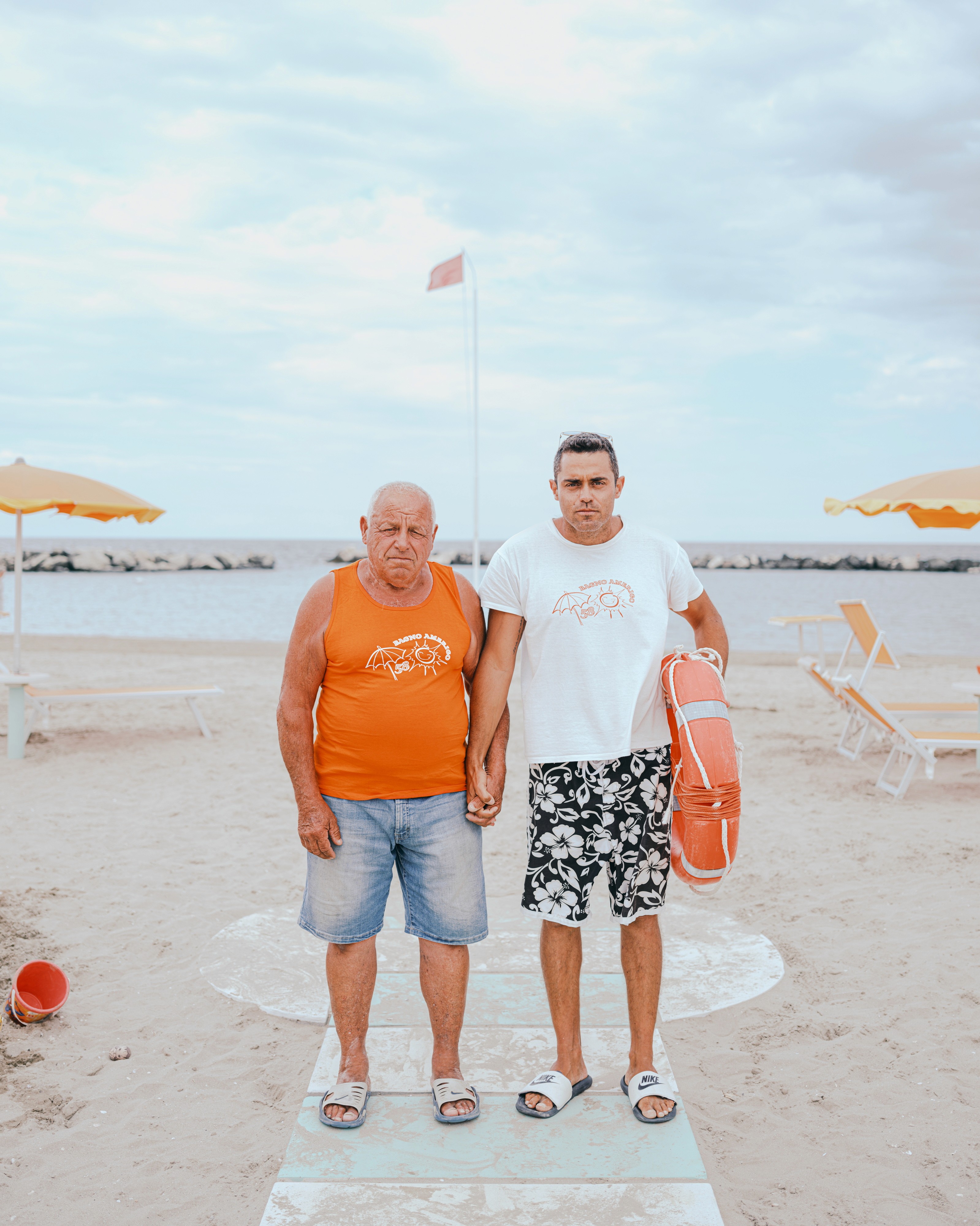
On a beach in Anzio, Italy, two men stand facing the camera. They wear the same t-shirt, marked with the number 58, the logo of a beach establishment. The father, in an orange tank top, carries on his body the marks of years of work. The son holds a life preserver under his left arm. With his right, he holds his father's hand. The same place. The same work. What draws the eye is not the setting, but the gesture between them.
It is a simple request. One that Valery Poshtarov, a Bulgarian photographer whose fourteen-year documentation of the Rhodope Mountains is held at MoMA and the MEP Paris, has been making to fathers and sons across fourteen countries: Albania, Armenia, Bulgaria, France, Georgia, Greece, Italy, Montenegro, North Macedonia, San Marino, Serbia, Slovakia, Switzerland, and Turkey. The project is called Father and Son. But it is less about photography than about what happens just before the picture is taken, the seconds in which a gesture that belongs to childhood suddenly becomes possible again between two adults.
Poshtarov words are simple: "the photographs are just a trace." What matters is the hesitation, the resistance, the moment a hand moves slowly from a shoulder down toward another hand. For some, it takes a second. For others, it never happens at all.
The project started with an ordinary fear. As a father of two young boys, Poshtarov became aware that one day they would no longer need to hold his hand on the way to school. That thought led him to photograph his own father and his grandfather, then ninety-five years old, two grown men returning to a gesture we associate with childhood. He kept the photograph in his archive. Then, during the early months of the pandemic, a woman approached him in the street, pushing a man in a wheelchair. She was holding a portrait of a young man tightly against her chest. This was our only son, she said. He passed away eight months ago. My husband would like a photograph with him. Poshtarov described it as "a sign of destiny." He started approaching other fathers and sons.
Each portrait is made in a place that belongs to the men in it. "The background is part of that story." Poshtarov says. "I choose it based on what is true for them, their work environment, their home territory, or a place that reflects what they share." The beach in Anzio. A garage. A doorway. As the project grows country by country, these images begin to function as a kind of visual anthropology. Personal stories that also describe a wider cultural identity.
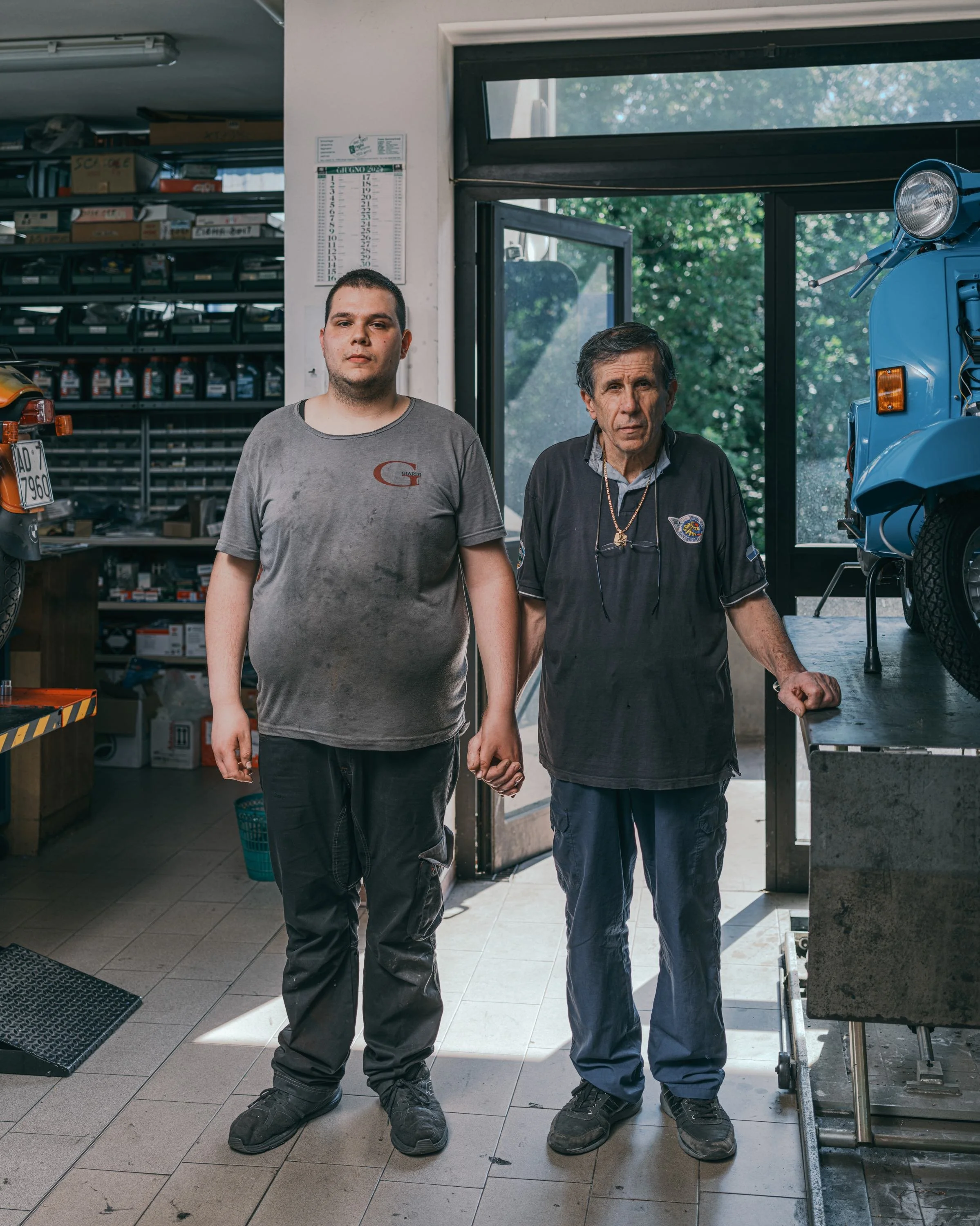
"Father and Son" by Valery Poshtarov, San Marino, 2024
When asked where he would choose to be photographed with his own sons, he told me he had already done it, not for the project, but for themselves. If he were to do it within the same framework, the place would need to be connected to their shared story. Somewhere on the road, perhaps, because he sometimes took his sons with him while travelling. Or in front of their home in Sofia. "Those images we made were more for the experience itself than for the image."
Poshtarov meets his subjects in two ways. Some he approaches by chance, on the street or at their workplace, asking them on the spot to stand together and hold hands. Others contact him through social media, having seen the project and wanting to take part. The dynamic is entirely different depending on which way it happens. In the first case, the request lands without warning. In the second, the men have had time to think about what they are about to do, and about each other.
But in both cases, something shifts the moment the camera is there. A gesture that would feel strange, or simply impossible, in the middle of an ordinary day becomes suddenly available. The camera does not capture an existing moment. It creates the conditions for one that would not otherwise exist. "Sometimes decades pass between the moment we let go of our father's hand and the moment we have the courage to hold it again," Poshtarov says.
He describes it as building a new set of social expectations, a temporary space in which it becomes acceptable for two men to do something that the rest of their lives has made difficult. In that space, fathers who have never expressed physical closeness to their sons reach out. Sons who have spent years constructing an identity at a distance find themselves holding a hand they had forgotten. When no one had time to prepare, it is almost always the son who pulls away first.
Poshtarov believes fathers and sons are becoming closer, more involved, more open. But not that the distance disappears, he told me:
"It is not only about father-son relationships, but also about cultural heritage and the gap between generations. [...] Even if tenderness becomes easier, that distance will still exist in other forms."
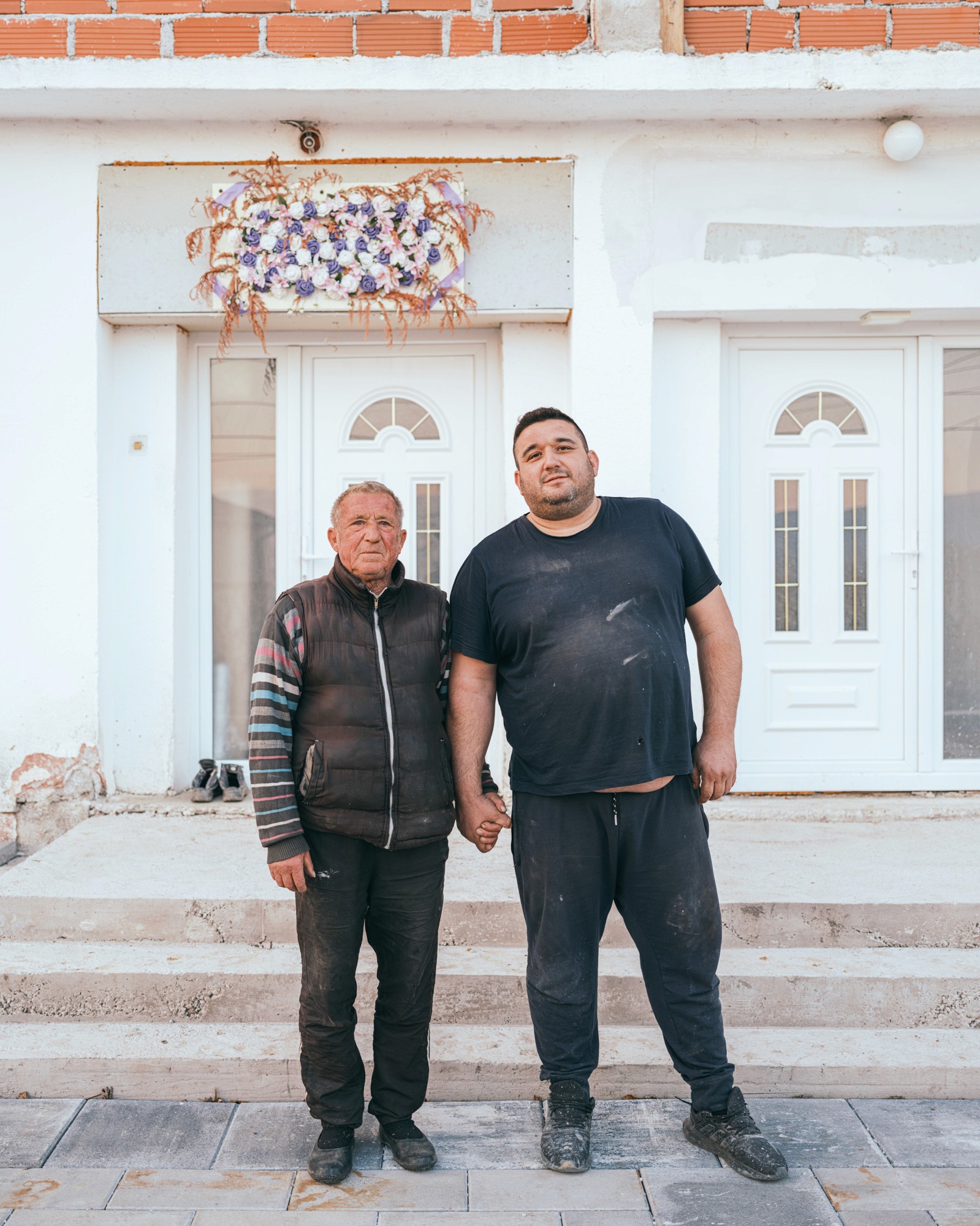
"Father and Son" by Valery Poshtarov, Dobroshte, North Macedonia, 2024
In 2024, the project received first place in the professional portraiture category at the Sony World Photography Awards.
For some of the men Poshtarov photographed, it was the only time. Not the last, there had never been a first. Photography made something possible that life alone had not. Some sons have written to him since, after losing their fathers. The photograph was still there. A moment that would not have existed without a camera, a stranger, and a simple request.
Thank you to Valery Poshtarov for taking the time to answer. You can find his work on instagram @valery.poshtarov and at poshtarov.net/
Article written by Eliott Vinot.
Share
Copy link